

Video creators now are the center of brand growth. For many large advertisers, creator-led video is now the primary driver of attention, trust, and business outcomes across social platforms, retail media, and emerging commerce formats.
Unilever CEO Fernando Fernandez announced in March 2025, his first month in the role, his plan to reallocate the company’s $10.2 billion annual marketing investment in social media and creators from 30% to 50% and increase its volume of influencer collaborations 20 times (Ad Age, 2025: “The new creator-led marketing playbook”). That level of commitment signals a permanent shift in how brands expect to reach consumers.
Despite this enthusiasm, every large brand struggles to deploy video creators at scale with confidence. The constraint is not talent or distribution, but effectiveness, predictability and governance.
Two creators with similar audiences, formats, and platforms can drive radically different outcomes. Brands usually discover this after spend is committed.
Brands Get Stuck in Chaos
In conversations with large advertisers and agencies, the same frictions surface.
Creative variance is extreme. Two creators with similar audiences, formats, and platforms can drive radically different outcomes. Brands usually discover this after spend is committed. Our partner Nielsen shows that creative quality can drive 30–50% of sales lift variance, often outweighing media factors (Nielsen, The Power of Creative, 2021).
Creators are trusted by consumers but not fully trusted by CFOs or the board.
Measurement is fragmented. Creator platforms such as CreatorIQ, GRIN, Aspire, Later Influence, and impact.com have professionalized discovery, workflow, and reporting. They were not designed to predict business impact at the creative level before launch.
Creative standards do not scale. Traditional brand guidelines translate poorly into creator ecosystems where authenticity, pacing, tone and emotional resonance matter more than polish or consistency.
Learning does not compound. Insights live in post-campaign decks rather than in workflow or technology systems that shape future briefs, creator selection and media investment decisions.
This leads to a familiar paradox: creators are trusted by consumers but not fully trusted by CFOs or the board.
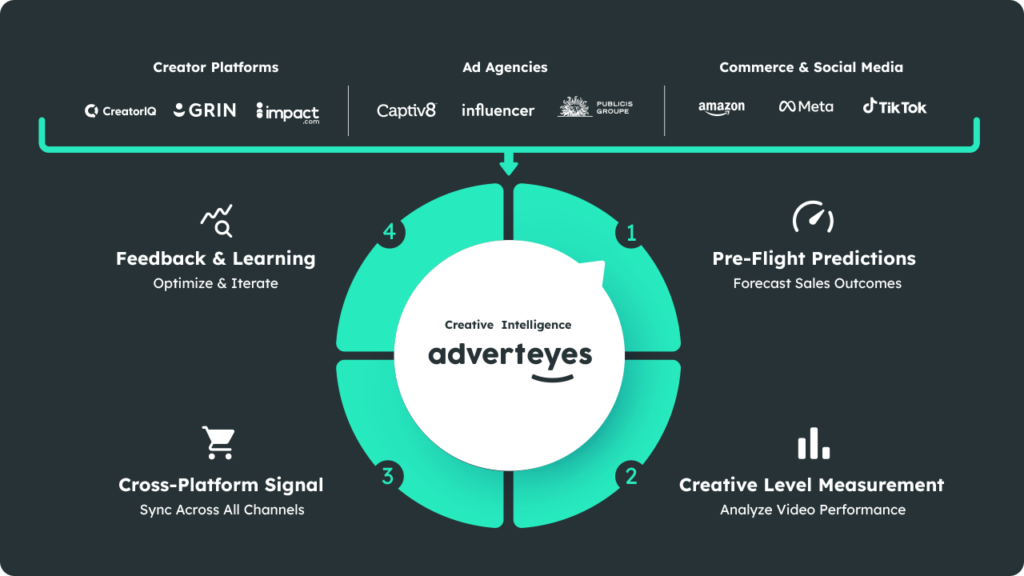
The 4 Pillars of Advertising Effectiveness in The Creator Economy
If video creators are to function as a growth lever, effectiveness must be reframed.
A modern framework requires four elements.
1. Pre-flight Predictions. Brands need a credible view of likely attention, emotional engagement, and sales contribution before content is scaled. This mirrors how other major media investments are evaluated.
2. Creative-Level Performance. The unit of truth cannot be the creator or channel alone. Outcomes are driven by collections of individual video assets and how they are placed and amplified.
3. Cross-Platform Signal. Creator content increasingly runs beyond organic social into paid social, retail media, CTV and live commerce. Measurement must travel with the asset.
4. Continuous Feedback Loop. Every campaign should make the next one smarter to drive incremental impact, not just better reported.
Creative intelligence becomes critical, not as a replacement for creator platforms, but as connective tissue across them.
Winning brands will not be those that work with the most creators, but those that learn the fastest from creator content and operationalize that learning at scale.
What Workflow Looks Like in Practice
In a modern operating model, creators ideate and produce content, increasingly using GenAI tools to accelerate scripting, editing, localization and iteration. Adobe’s Future of Creativity research shows that a majority of creators now use AI tools regularly, primarily to speed production rather than replace originality (Adobe, 2023). Fiverr’s creator economy data points to similar trends across video and social formats.
Before content is scaled, predictive signals are applied to each video to estimate attention capture, emotional response, and likelihood of driving business outcomes, based on how real people have responded to similar creative historically. We’ve accomplished this through continuous synchronization of MMMs and creative predictions data. (Link to LinkedIn Post on MMMs and creative.)
Assets are then ranked, selected or refined, and selectively targeted and amplified. Underperforming videos are fixed or deprioritized early. High-potential videos are reused across paid, retail and commerce environments.
After launch, results feed into brand-specific playbooks that define what works by category, audience, platform, format and creative strategy (link to Playbooks). This creates a compounding system rather than a series of disconnected creator bets.
This is the role we see for Adverteyes: providing creative-level predictive and diagnostic intelligence that integrates with existing creator and ad tech systems, rather than competing with them.
How Agencies and Platforms Fit
Large agency groups are already investing heavily in creator infrastructure. Publicis has built scaled creator capabilities through platforms such as Captiv8 and Influential. Independent agencies like VaynerMedia have long demonstrated that creator-led storytelling with smart media investment drives business outcomes.
Yet across the industry, decision intelligence remains missing.
When predictive creative signals and playbook analytics are embedded throughout the advertising lifeycle, agencies gain confidence in recommendations, brands gain governance, and creators receive clearer briefs that protect authenticity and improve performance.
Why Video Creators Matter More Than Ever To Brand Growth & ROI
Creators sit at the intersection of trust, technology and commerce.
Edelman’s Trust Barometer shows that people trust “someone like me” and independent creators more than brands or traditional advertising, particularly among Gen Z and Millennials (Edelman Trust Barometer, 2023–2024). Meta and TikTok research also show that creator-led video typically outperforms brand-only ads on attention and engagement metrics, which remain prerequisites for sales impact (Meta Creative Effectiveness Playbook; TikTok Marketing Science).
Creators also are pioneering live social commerce and AI-assisted production. McKinsey estimates that social commerce could account for $2 trillion globally by 2025, with video-led creator formats as a primary driver (McKinsey, The Future of Social Commerce).
Winning brands will not be those that work with the most creators, but those that learn the fastest from creator content and operationalize that learning at scale.
Video creators are no longer the question.
Effectiveness is.
And effectiveness, ultimately, is a systems problem.