
Background
For years, the advertising industry has been divided: does media placement or creative quality drive campaign performance?
In practice, both have typically been planned and measured in isolation, media teams optimising for placement efficiency, creative teams optimising for storytelling, with no unified framework to understand how the two interact.
"Billions in ad spend have underperformed because neither side measured the full picture."
This disconnect has come at a cost. Billions in ad spend have underperformed because neither discipline was measuring the full picture.
To address this, Adverteyes partnered with Adelaide and Teads on a first-to-market joint study, examining whether campaigns that scored highly on both media quality and creative quality delivered meaningfully better brand outcomes than those optimising only one.
Brand lift outcomes were independently measured by Cint across more than 16,000 respondents.

Adelaide
Attention quality platform. Uses placement and device data, eye-tracking research, and full-funnel outcome data to predict the likelihood of an ad capturing attention and driving impact.
Adverteyes
Creative intelligence platform. Uses facial coding and behavioural data to measure audience attention and emotion, scoring creative executions with an overall Attention Potential Score.
Teads
Global omnichannel media platform. Provides the premium publisher environment in which campaigns ran, enabling comparable exposure conditions across all six campaigns in the study.
‘Attention is a Team Sport: Why Media and Creative Quality Must Work Together’
As featured in WARC, April 2026
Key Takeaways
Attention requires both media and creative alignment
Media quality determines whether an ad has the opportunity to be noticed; creative quality determines whether that attention is sustained. The strongest results emerge when the two work together.
Synergy drives exponential lift
Campaigns that ranked highly on both the Adelaide AU (media quality) and Adverteyes APS (creative quality) significantly outperformed those that only optimised one lever.
Creative quality is measurable, not subjective
The Adverteyes score (Attention Poterntial) trained on 18M+ webcam observations across 90K+ ads in 90 countries, transforms creative effectiveness into a quantifiable, repeatable variable evaluated with the same rigour as media metrics.
Siloed optimisation leaves performance on the table
When media and creative quality were independently strong but strategically aligned, brand impact rose by 3 to 4x. The insight isn’t just measuring each, it’s interpreting them together.
Results
Across six campaigns spanning CPG, travel, fashion, alcohol/beverage, and B2B — running across display and online video (OLV) for between one and nine months — the data was clear:
Brand awareness lift: high AU & APS vs. low AU & APS
Source: Cint, 2025 advertiser brand lift study
Brand Awareness
Campaigns in the top tier (high AU + high APS) delivered 5.3x stronger brand awareness lift than bottom-tier campaigns, and exceeded Cint’s Q1 2025 Digital Media Benchmark by more than 2x.
Top-tier campaigns outperformed the Cint benchmark by 2.5x and showed meaningful positive lift, while lower-scoring campaigns showed no lift at all.
"The same budget delivers greater impact when strong creative appears in high-quality media environments."
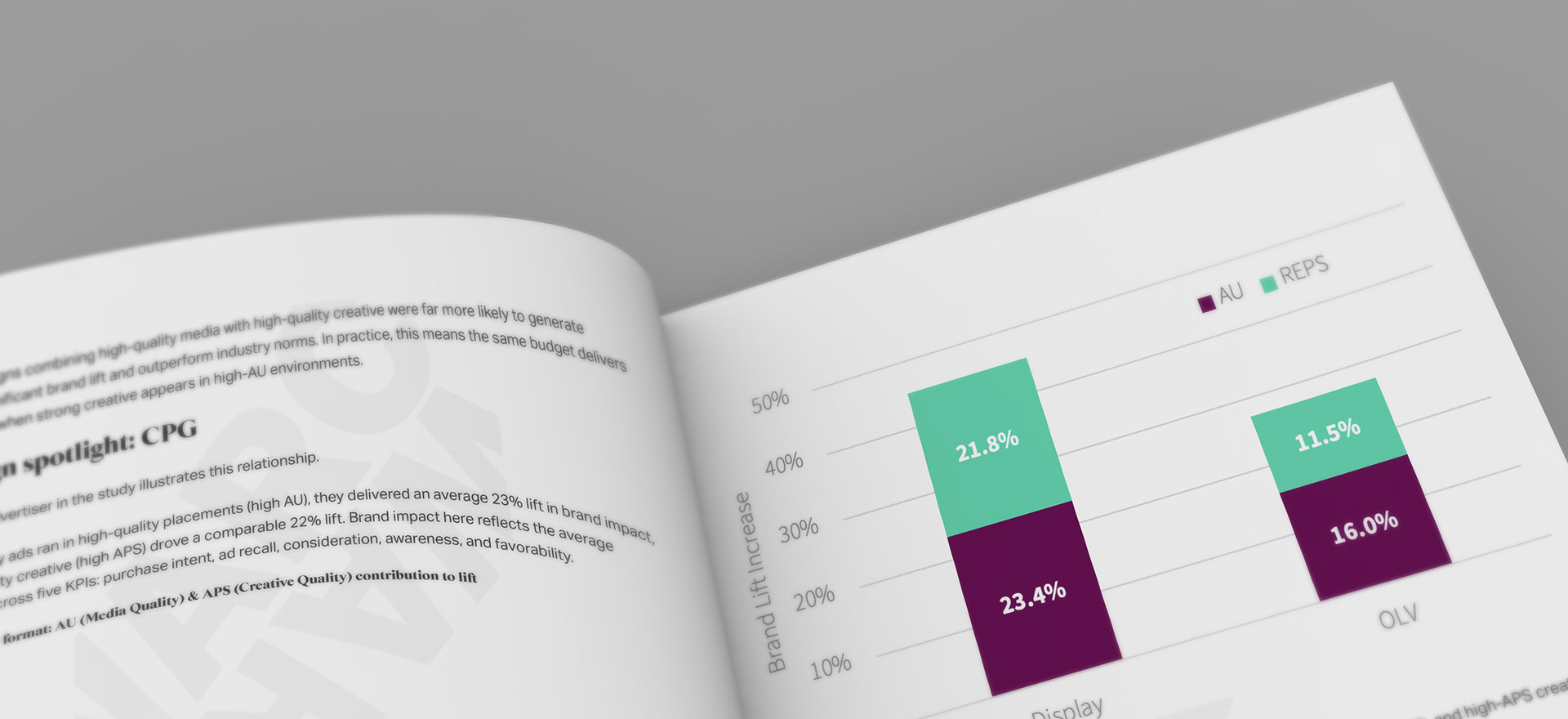
For one major CPG advertiser, the individual contributions were near-equal: high-quality media placements (high AU) delivered a 23% lift in brand impact, while high-quality creative (high APS) drove a comparable 22% lift, across five KPIs including purchase intent, ad recall, consideration, awareness, and favourability. In video placements, high-AU media produced a 16% lift, with high-APS creative contributing an additional 12%.
Brand lift was measured independently within each campaign and then compared across campaigns, accounting for baseline differences in brand size, category norms, and pre-existing awareness — ensuring results reflect true incremental impact.
Outcome
The study confirms that the media vs. creative debate is a false choice. Both matter, and their impact is greatest when intentionally aligned.
"Strong creative in weak environments, or premium media with forgettable messaging — both are a waste."
Advertisers who adopt an integrated, attention-led approach — using AU to ensure strong creative runs in high-quality environments, and APS to pressure-test creative before launch — can consistently recreate the conditions that drive stronger brand performance and greater ROI from every dollar spent.
Those who don’t risk the two most common and costly mismatches in advertising: strong creative in weak media environments, or premium media placements carrying forgettable messaging.
The practical blueprint:
- Use AU and APS together to evaluate both sides of the attention equation before and during campaign flight.
- Optimise media in-flight using AU to redirect spend toward higher-quality inventory; validate creative upfront using APS to select assets most likely to perform.
- Benchmark and scale what works — identifying the conditions that consistently outperform brand KPI norms and replicating them across future campaigns.