

Generative AI can make new versions of an ad in minutes. That’s a big opportunity, as long as the versions are different enough to learn from. To see where the real differences lie, Adverteyes’ Data Science and R&D teams recreated 96 real ads with AI. They scored every version against a benchmark of more than 30,000 real viewing sessions. The study was led by Mladen Ðalto, R&D Engineer in Computer Vision and Machine Learning, and Cristian Donos, Principal Data Scientist.

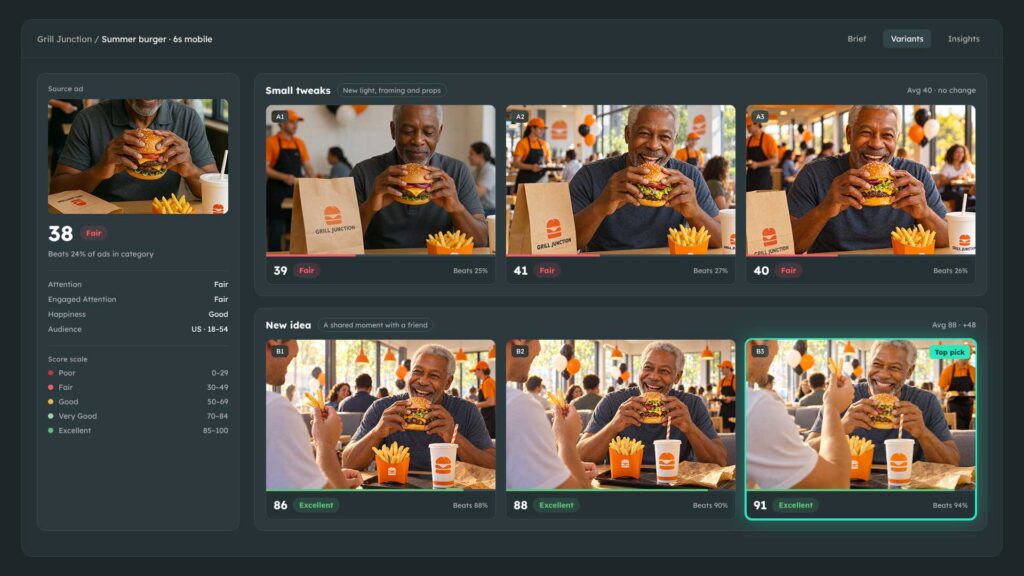
Two things stood out. AI can refresh a proven ad without losing its engagement. And near-identical variants get near-identical responses. Clear differences in how audiences react only appear when the creative itself is meaningfully different. So the way to find your next winner is to go wide: make lots of varied AI ad variants, score them all, learn from every one and back the pockets of success.
Key Takeaways
- AI can refresh a proven ad without losing its engagement.
Recreations stayed true to their source. Expect a refresh to hold performance, not lift it. - Near-identical variants get near-identical responses.
Small tweaks barely change how audiences react, so there is little to learn from comparing them. - Varied creative is where the winners are.
Meaningfully different versions produce clear differences in response. Make lots of them, score them all and back the ones that stand out. - Make room for exploration.
Set aside a share of production and testing budget for distinct ideas. Generate wide, test, learn and run selectively.
THE RESEARCH
How We Ran the Study
We started with 105 real ads, mostly six-second mobile spots from ten markets. A verified audience had already watched every one, across more than 30,000 viewing sessions. Many came in several versions of the same campaign, such as cut-downs, alternate endings and versions with and without a celebrity.
For 96 of them, an AI model wrote a second-by-second description of everything seen and heard. A text-to-video model turned that description alone into a new ad of the same length and format. We then scored every version on three signals our clients use: Attention, Engaged Attention and Happiness.
FINDING 1
AI Can Refresh a Proven Ad Without Losing Its Engagement
Is it still the same ad? Yes. 84% of recreations were closer to their own source than to any other ad in the set. In content, a typical recreation sat closer to its original than two versions of the same campaign do.
Does it keep the engagement? Largely, yes. Most recreations moved predicted engagement less than re-testing the original with a new audience would. That held for 94% on Engaged Attention, 79% on Happiness and 78% on Attention.
So an AI refresh tends to hold the source ad’s performance rather than improve or damage it. That makes it a reliable way to extend the life of a proven ad, and you can check it before it reaches a media plan.
FINDING 2
Near-Identical Ads Get Near-Identical Responses
Next, we looked at how different two ads need to be before audiences respond differently. We ranked every pair of human-tested ads from most to least alike. Then we checked how consistently real viewers and our model picked the stronger one.
Where the two zones fall, from the most similar pairs (left) to the least similar (right):
Too close to call
The most similar ~4% of pairs
91% of same-campaign variants sit here. The model is near a coin toss; people do only a little better.
Useful calls
All other pairs
The model is clearly above chance, a few points behind a real half-audience (on Attention, within two).
The pattern is clear. For the most similar pairs, audiences respond in much the same way. 91% of same-campaign variants sit in this zone, where any difference in response is too small to measure reliably, even with real viewers. Once the creative is meaningfully different, clear differences appear, and our model picks the stronger ad nearly as reliably as a real audience.
The same held when each ad was swapped for its AI recreation. What matters is how different the versions are, not how they were made.
Testing lots of near-identical versions mostly confirms what you already know. Testing versions with a new story, a new emotional hook or a new opening shows how people really respond. That’s where your next winner comes from.
Small tweaks protect performance. Distinct ideas discover it.
WHAT IT MEANS
Make Room for Exploration
Most creative budgets go on refreshing and re-testing proven winners. Our data shows the limits of that. AI refreshes tend to hold the source ad’s performance rather than improve it, and 91% of same-campaign variants are too close for real audiences to call.
Refresh testing still has a job. It’s an insurance policy that checks you haven’t broken a good idea. But the bigger return per test comes from highly differentiated ideas, even if most of them never make it to air.
AI makes production cheap and prediction makes screening fast. Together they make exploration affordable. So set aside a deliberate share of production and testing budget for it. Generate wide, test, learn and run selectively. Over time you build a knowledge base of themes and executions that shows which stories, hooks and openings work for your brand.
AI makes production cheap and prediction makes screening fast. Together they make exploration affordable.
IN PRACTICE
Three Ways to Use AI Ad Variants
Go wide, score everything and back what stands out.
REFRESH
Tired winners
Rebuild a fatigued ad with a new cast or setting. Score it against the original before anyone books a shoot.
ADAPT
Formats and markets
Make platform, format and market versions of a proven ad. Check each one keeps the original's engagement before launch.
EXPLORE
Real creative range
Generate lots of truly different variants and let Adverteyes score them all. Learn from every one and run only the strongest.
This works inside the tools that make the ads too. With the Adverteyes MCP, generative ad platforms such as Nativeads.ai can score each variant as it’s created. Making and ranking happen in the same workflow.
WHY TRUST THE SCORES
Can You Trust a Predicted Score?
Before scoring AI-made ads, we checked our model against real audiences on the original ads. Its predicted reactions stayed as close to a real audience as a second audience would for 89–98% of each ad’s timeline, depending on the signal.
What We Test Next
Real audiences watched the original ads, and the recreation scores are predictions. Testing recreations with real audiences comes next, along with brand distinctiveness: whether AI versions keep the brand assets that make an ad yours.
Put Your Budget Behind Your Best Creative
Be bold with AI variants. Go wide, make them truly different and let Adverteyes score every one. It works inside your generative ad tools through the Adverteyes MCP, so you learn from every idea and run only the ones that earn their place.
Get in touch to add Adverteyes to your GenAI workflow.