
EXECUTIVE SUMMARY
Emotion isn’t the Finish Line
Charity and PSA advertising tends to work in difficult emotional territory, often on a smaller testing budget than commercial categories. We analyzed 12 charity and PSA ads across the US and UK to see how Attention, emotional Engagement and the branding moment line up across the length of each ad. In most cases the creative built Attention and emotional Engagement effectively. However, what it didn’t consistently do was keep that response aligned with the moment the branding appeared.
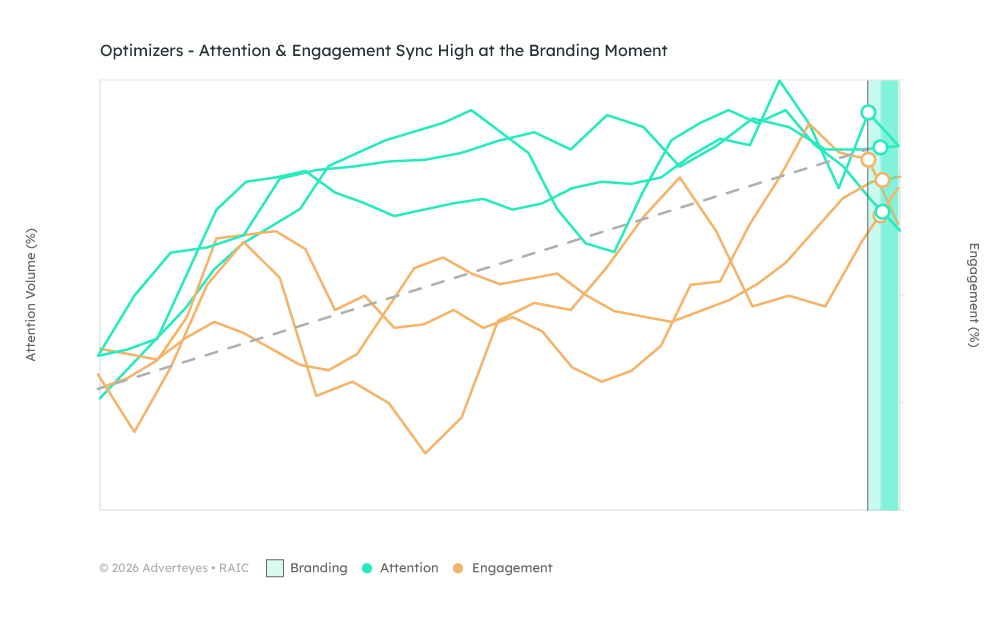
Nine of the twelve ads in this study had their peak Attention and/or Engagement fall out of sync with the moment the branding appeared, meaning Attention, Engagement, or both, had already peaked and begun to fall before the branding moment arrived (the Optimizer, Fumbler and Plunker framework below sets out the full scoring rule). After all, before an ad can influence donation or action, viewers first have to see it and stay engaged with it. This paper looks at exactly that: where Attention and Engagement lined up with the branding moment (and where they didn’t).
This paper sets out the full research: first, how the study was designed and tagged; then the benchmark gap between charity/PSA and commercial creative; the three branding-moment outcomes we identified; the specific creative devices behind attention, happiness, negative emotion and surprise across the 12 ads; and finally, an audience pattern worth building into the creative brief rather than fixing in media planning.
Key Takeaways
What we found across the 12 ads, in brief:
- 9 of the 12 ads (75%) let their peak Attention and/or Engagement fall out of sync with the branding moment.
- Only 3 ads, the ‘Optimizers’, landed branding right at the Attention and Engagement peak. As a result, the rest were Fumblers or Plunkers.
- Charity and PSA ads work in a different emotional register than commercial ads: lower average Happiness, higher average Negative emotion in this benchmark.
- In fact, sound, facial close-ups and relationship themes were the strongest Attention and Happiness drivers across the study set.
- Attention was higher among viewers 50+ than younger viewers, an exploratory pattern worth testing at brief stage rather than a proven effect.
- The fix isn’t always more emotion. It’s making sure the brand shows up while that emotion is still doing its work.
"Feeling something isn’t the same as remembering who made you feel it. "
BACKGROUND
Why This Study
Charity advertising has an unusual problem. The hardest part of the creative can work exactly as intended, the audience can feel exactly what the brief set out to make them feel and the campaign can still miss its moment.
It’s a category that rarely gets the scrutiny commercial advertising takes for granted. Charity and PSA campaigns account for an estimated 3-4% of network TV ad spend, yet fewer than 0.6% of the campaigns in Adverteyes’ database of 65,000+ tested videos are non-profit work. As a result, very little is known about which creative techniques actually capture attention and convert it into an emotional connection with the brand, since most charities and agencies can’t justify a testing budget on top of already-stretched production costs.
For the agencies that do test, however, the payoff is visibility into where the creative is landing, not just where the brief intended it to land. For example, BBDO has used Adverteyes for its PSA work for Sandy Hook Promise for several years, across multiple award-winning campaigns, including a 2024 Silver Effie for “A Teddy Bear’s Dream,” a 2023 Gold Effie for “Just Joking,” and Emmy Awards for “Teenage Dream” (2021) and “Back-to-School Essentials” (2019).
"We didn't use the testing to tell us what the idea should be. We used it to understand where the idea was landing, to make sure the brand was still part of the moment when it did."
— [Name], [Title], BBDO — quote pending BBDO’s review and sign-off
METHODOLOGY
How the Study Was Run
The study used Adverteyes’ Human Measurement: real, opted-in viewers watching naturally on their own device, with attention and emotion measured via their front-facing camera (no images are stored). In this study, Engagement refers to the combined emotional response measured during the ad, including any emotion expressed, whether Happy, Sad or otherwise. In other words, it is not a measure of brand recall, purchase intent, donation behavior or campaign conversion. Instead, each ad was evaluated relative to its own baseline, to control for differences in creative brief, sample composition and testing protocol between campaigns.
| Ads tested | 12 (6 US, 6 UK; 30s and 60s formats) |
|---|---|
| Respondents per ad | ~150, evenly split male/female |
| Total views across the study | 2,666 |
| Measurement approach | Adverteyes Human Measurement (webcam-based, opted-in, relative to each ad's own baseline) |
Table 1. Methodology snapshot. The 2,666 figure is the sum of views across all 12 ads, not the count for any single ad.
How to Read the Findings
A quick guide to the terms used throughout this paper:
Attention: the share of viewers visually engaged with the ad at each moment, tracked frame by frame.
Engagement: the combined emotional response measured during the ad, covering any emotion expressed (Happy, Sad or otherwise). That said, it’s not a measure of brand recall, purchase intent, donation behavior or campaign conversion.
Peak: the point in the ad where a given metric (Attention, Engagement, Happiness, Negative emotion or Surprise) reaches its highest level, relative to that ad’s own baseline.
Branding moment: the sequence where the logo, call to action or contact details are present on screen.
Tagging and Classification
Each ad was independently tagged scene by scene against a shared set of creative categories: characters, expressions, themes, plot development or narrative twists, music and sound, voice-over, on-screen text, graphics, color palette and mood, framing and camera angle, logo and branding placement, and call to action. Tagging categories were then aggregated by common theme and contextual relevance, since this kind of pattern recognition is still difficult to do reliably with computer vision alone.
For each ad, we identified where Attention, Engagement, Happy/Happiness, Negative emotion and Surprise peaked and compared those peaks to the timing of the branding moment (the point where the logo, call to action or contact details appeared). That comparison is what produced the three branding-moment outcomes covered later in this paper.
THE BENCHMARK
How Charity Ads Differ from Commercial Advertising
Charity and PSA ads work in a different emotional register than most commercial work. In this benchmark dataset, commercial categories showed higher average and peak Happiness, while charity and PSA work more often navigates through discomfort, fear, sadness, guilt or urgency, before it can resolve into empathy and human connection.
As a result, that’s a harder emotional environment to work in, and exactly the backdrop this study set out to test. Even so, the bigger opportunity isn’t necessarily more emotion. Rather, it’s making sure the brand shows up while that emotion is still doing its work.
| Benchmark | Sample Size | Attention Volume (avg) | Engagement (avg) | Happiness (avg / max) | Negative (avg / max) | Valence (avg / max) |
|---|---|---|---|---|---|---|
| Charity / PSA / non-profit norms | 223 videos, 45,936 views | 0.693 | 0.113 | 0.030 / 0.064 | 0.061 / 0.097 | -0.010 / 0.045 |
| Top 20 commercial categories | 19,278 videos, 3,735,539 views | 0.702 | 0.125 | 0.044 / 0.087 | 0.059 / 0.094 | 0.004 / 0.063 |
Table 2. Charity/PSA vs. Commercial Benchmark. Charity/PSA norms vs. the top 20 commercial categories, based on different sample sizes (223 vs 19,278 videos). US + UK, 20-70 second ads. Commercial ads showed higher average and peak Happiness and lower average Negative emotion, than the charity/PSA norms in this dataset; this reflects a difference in emotional approach, not a claim that one category is more effective than the other. Source: Adverteyes' proprietary database [confirm snapshot date]; both samples are drawn from the same database and inclusion criteria as the 65,000+ figure above.
As a result, that’s a harder emotional environment to work in and it’s exactly the backdrop this study set out to test. Instead, the bigger opportunity isn’t necessarily more emotion. It’s making sure the brand shows up while that emotion is still doing its work.
Harder emotional territory doesn’t excuse a missed brand moment. It raises the stakes for landing one.
THE FRAMEWORK
Optimizer, Fumbler, Plunker
At first glance, the assumption behind a lot of charity creative is straightforward: if we can make people feel strongly enough, the ad is working. However, the findings tell a more nuanced story.
Overall, the creative was generating Attention and Engagement. But in many cases, Attention or Engagement had already fallen by the time the branding appeared, reducing the opportunity to connect that response with the brand. So, emotion isn’t the finish line for a charity ad, it’s the opportunity and the creative’s job is to connect it to the brand before it fades.
| Segment | What It Means | Share of Study Set | Example |
|---|---|---|---|
| Optimizer | Attention and Engagement both peak at the branding moment | 25% | UNICEF, Arthritis Research UK, NCDV – Abusers Always Work from Home |
| Fumbler | Engagement peaks but Attention has already dropped by the branding moment | Part of the 75% missed opportunity | Age UK |
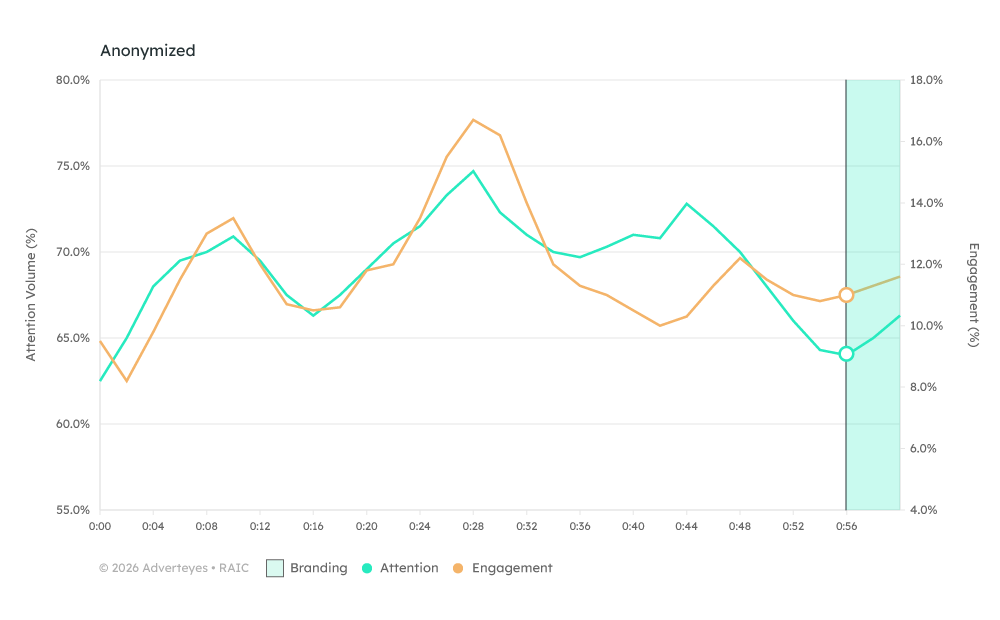
| Plunker | Both Attention and Engagement are low at the branding moment | Part of the 75% missed opportunity | Anonymized |
Table 3. How the 12 ads split across the three branding-moment outcomes. Named examples are as identified in the underlying study; the study does not separately name individual Plunker ads.
The creative was generating Attention and Engagement. But in many cases, Attention or Engagement had already fallen by the time the branding appeared, reducing the opportunity to connect that response with the brand. Emotion isn’t the finish line for a charity ad. It’s the opportunity, and the creative’s job is to connect it to the brand before it fades.
We grouped the 12 ads into three outcomes, based on where Attention and Engagement sat at the moment the branding appeared: three of the twelve ads (25%). ‘the Optimizers’ placed branding right at their Attention and Engagement peak. The remaining nine (75%) did not: a missed branding moment here means Fumbler or Plunker, where either Engagement peaked without Attention still being high, or both were low when the branding appeared. The framework is a way to identify creative questions worth testing.
| Creative Device | Ads Using It (of 12) | Share |
|---|---|---|
| Thematic musical progression | 10 | 83% |
| Facial close-ups | 9 | 75% |
| Relationships / togetherness / empathy | 4 | 33% |
| Distinct sound effects | 4 | 33% |
| Revelatory text | 4 | 33% |
| Animals | 3 | 25% |
Three ads got the timing right. The other nine had the harder job and mostly missed it.
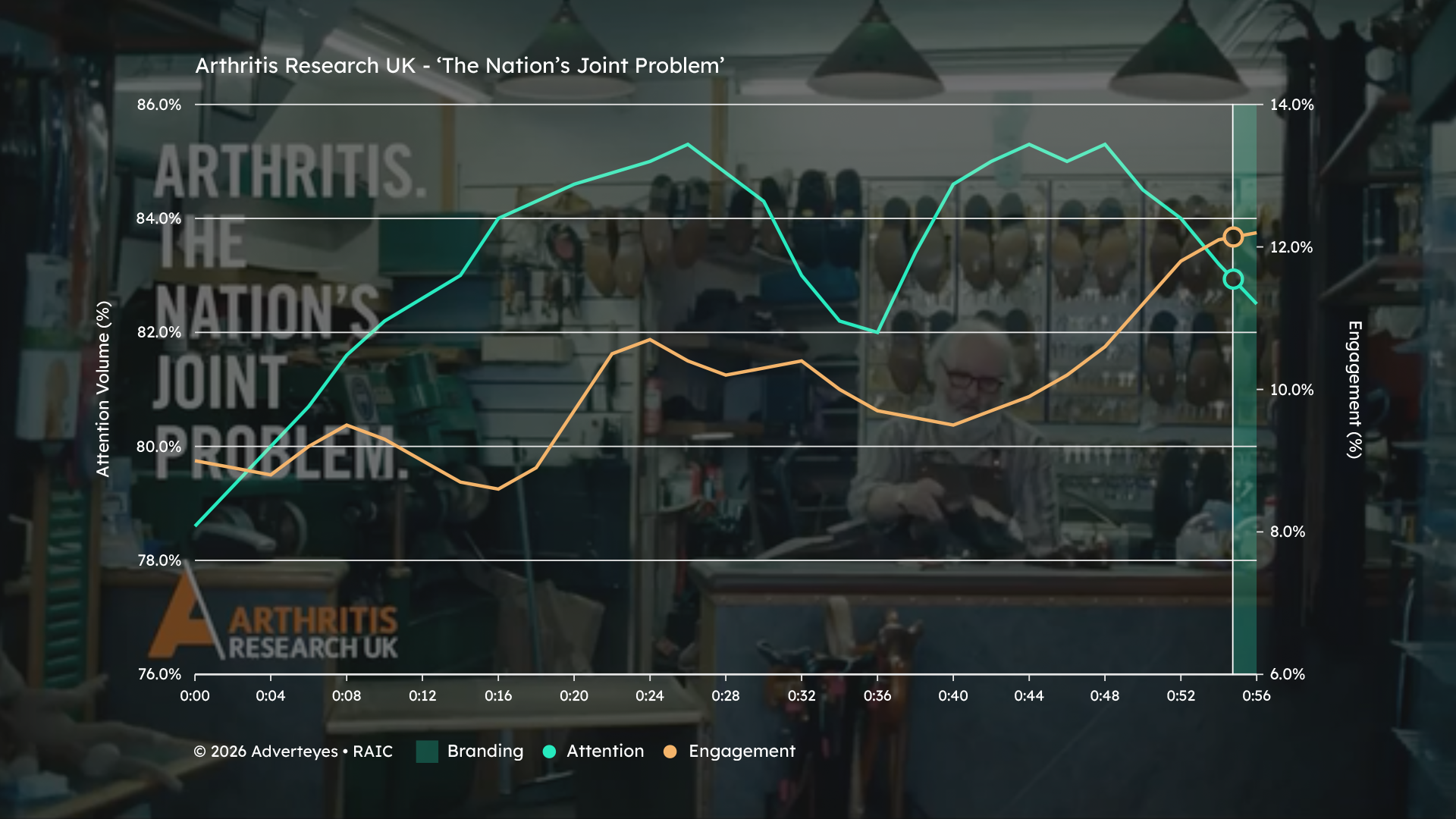
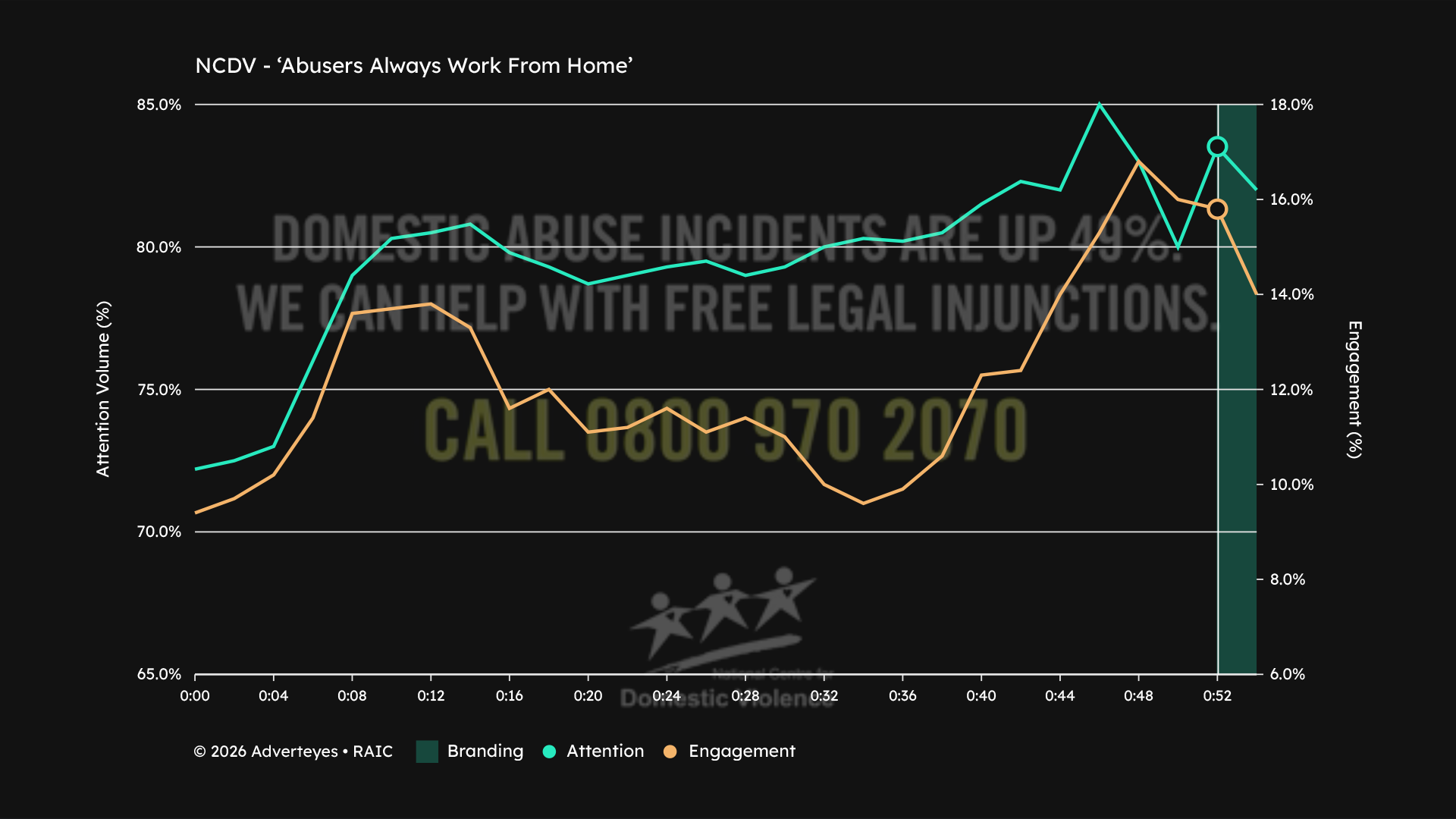
Fig 1. Optimizer Examples:
UNICEF, Arthritis Research UK and NCDV all build their trajectory of audience Attention and Engagement and hit the branding moment at their peak.
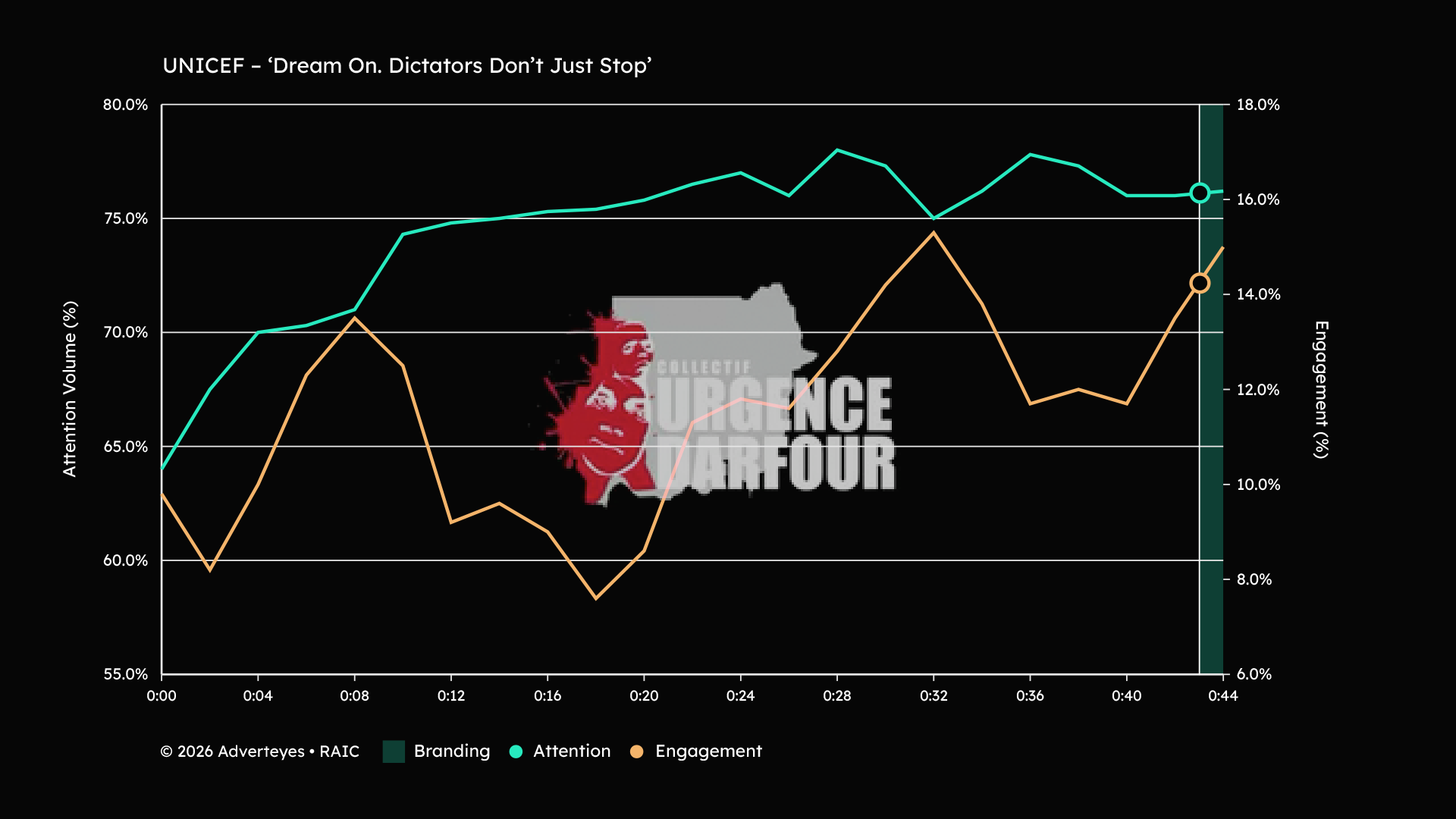
UNICEF: website URL, call to action and logo land together at 45–48s, right as Attention and Engagement peak.
Arthritis Research UK: contact details, slogan and logo at 56–60s, timed to the emotional high point.
NCDV Abusers Always Work from Home : slogan, call to action, contact and logo sequenced across 47–60s, sustaining the moment rather than cutting it short.
What the Optimizers Did Right
Only one in four ads was an Optimizer. The other three-quarters, however, missed the opportunity in different ways: some built Engagement but lost Attention before the branding appeared, while others never built enough Attention or Engagement in the first place. Even so, the fix isn’t always more emotion — moving the end card is one option worth testing against your own creative, not an automatic recommendation for every ad.
By contrast, Age UK is the clearest Fumbler in the study: an emotionally engaging end scene, but Attention had already dropped by the time the slogan, contact details and logo appeared at 35-40s, missing the chance to reinforce a positive emotional connection with the organization while viewers were still watching closely.
Fig 2. Fumbler Example
Engagement Peaks but Attention drops towards the Branding Moment
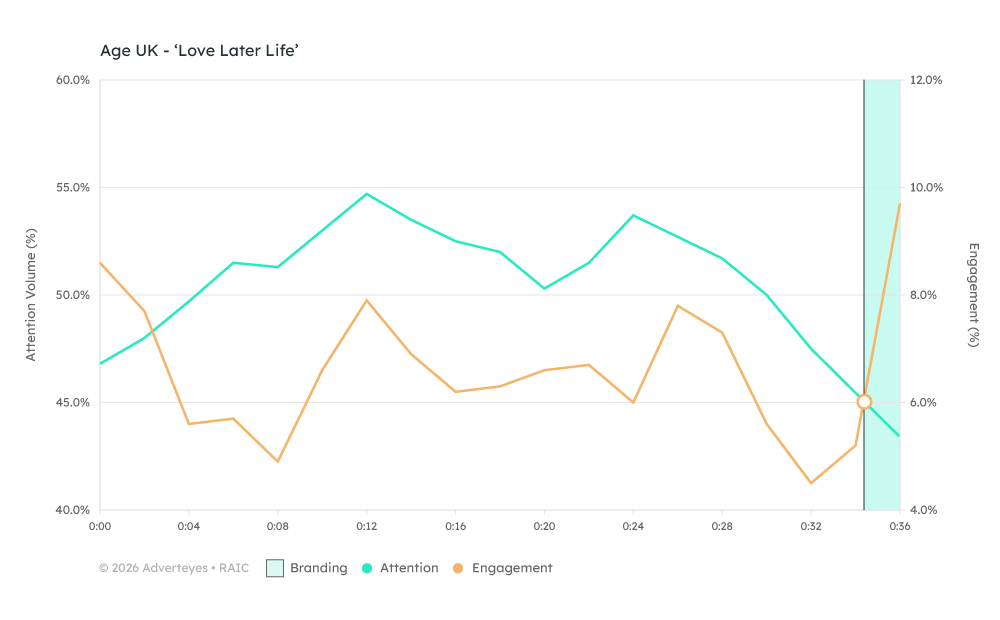
Fig 3. Plunker Example
The missed opportunity for peak Attention and Engagement to surface the brand.
CREATIVE ANALYSIS
Creative Lessons from the Data
With a sample of 12 ads, these aren’t prescriptions for every charity campaign. They’re patterns observed in this study set, useful as questions to test against your own creative rather than rules to follow blind. The counts below show how often a creative device appeared in ads that scored well on a given metric (they show association, not that the device caused the result). The categories below mix creative themes (for example, relationships/togetherness/empathy) with executional devices (for example, facial close-ups, sound effects) — both are treated as observed creative features rather than a strict production taxonomy, and categories are not mutually exclusive.
A device that shows up often in the data isn’t a formula. It’s a question worth testing on your own creative.
Attention: What Kept Viewers Watching
First, sound was a recurring feature around key attention moments in the study set: 10 of 12 ads (83%) used a distinct musical progression to build attention during key scenes, from suspenseful builds to deliberately upbeat or ironic soundtracks. Similarly, close-ups reinforced this (9 of 12 ads/75%) used facial close-ups, often anchoring a single focal point and pairing the shot with a matching emotional expression.
| Creative Device | Ads Using It (of 12) | Share |
|---|---|---|
| Thematic musical progression | 10 | 83% |
| Facial close-ups | 9 | 75% |
| Relationships / togetherness / empathy | 4 | 33% |
| Distinct sound effects | 4 | 33% |
| Revelatory text | 4 | 33% |
| Animals | 3 | 25% |
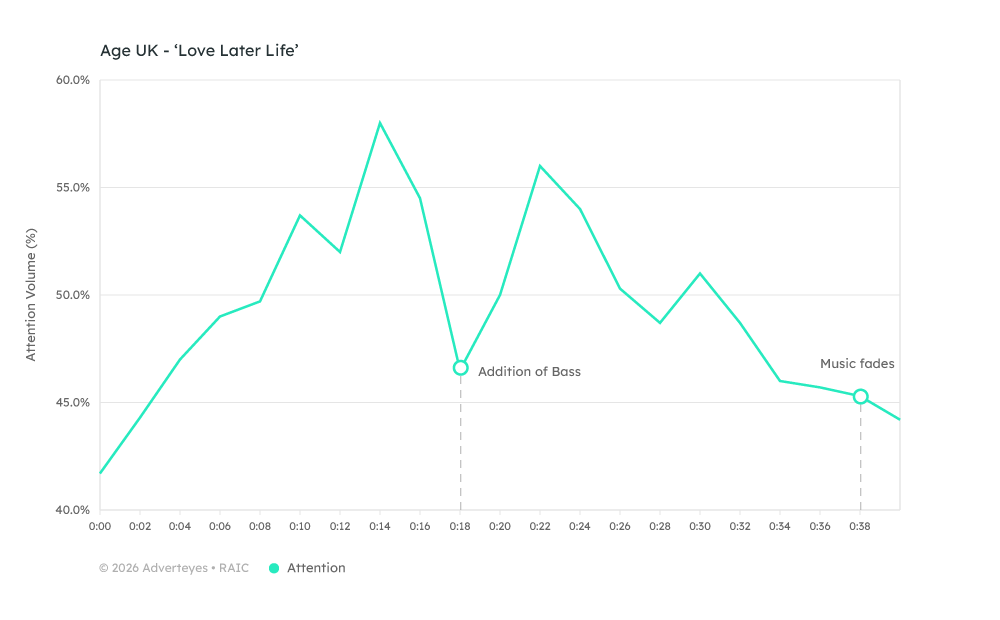
Fig 4. Attention: Thematic Musical Progression
WWF’s ‘Threads’ ad has a suspenseful build from 0-48s, with the musical progression reflected in the arc of attention. As a violin begins (see Crescendo), for example, this coincides with the rising trajectory of Attention. Similarly, in the Age UK example, the addition of a bass note coincides with a renewed rise in the Attention curve.
Happiness: A Different Route to Positive Emotion
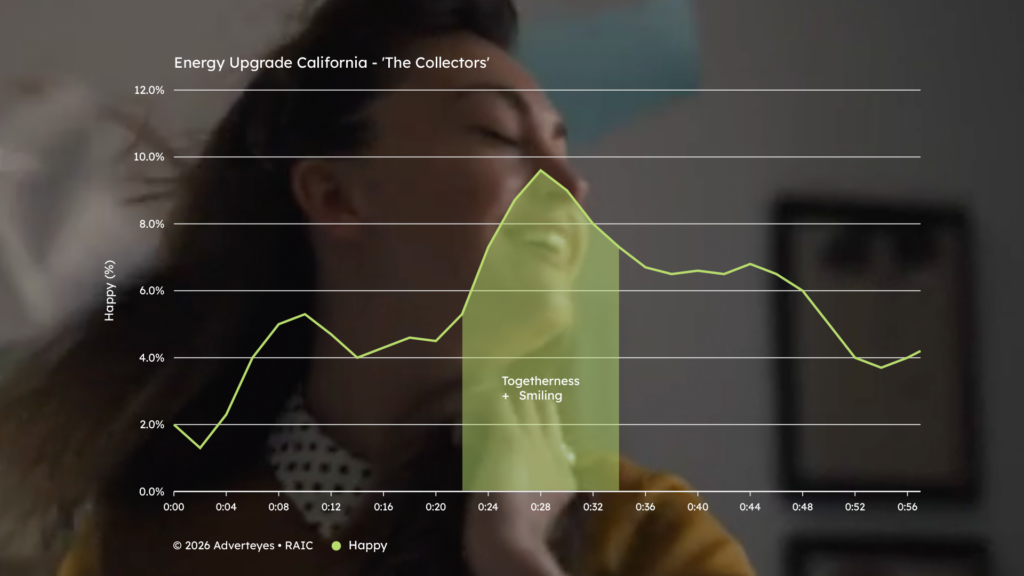
Where commercial ads typically use humour to trigger positive emotion, charity ads by contrast lean on human connection instead. In fact, 9 of 12 ads (75%) built happiness through relationships, togetherness and empathy: cooperation, shared humanity, compassion and civic duty, rather than jokes or wit.
In other words, a possible explanation is emotion mirroring: seeing people smile on screen may prompt viewers to smile too, which could help explain why relationships and togetherness themes track so closely with the Happiness curve. That said, this is an interpretation rather than a mechanism this study directly tested.
| Creative Device | Ads Using It (of 12) | Share |
|---|---|---|
| Relationships / togetherness / empathy | 9 | 75% |
| Laughter / smiling | 5 | 42% |
| Musical progression / climax | 5 | 42% |
| Revelatory text / logo / voice-over | 5 | 42% |
| Irony / contradiction | 4 | 33% |
Fig 5. Happiness Curve: Relationships & Togetherness
A possible explanation is emotion mirroring: seeing people smile on screen may prompt viewers to smile too, which could help explain why relationships and togetherness themes track so closely with the Happiness curve. This is an interpretation rather than a mechanism this study directly tested.
Negative Emotion: Used With Purpose
Negative emotion isn’t the problem, it’s more that unresolved negative emotion is. 6 of 12 ads (50%) used dark imagery or color palettes alongside facial distress, pain or fear to sharpen a narrative turn, rather than triggering negativity through poor execution. Importantly, that distinction matters: this section is about negative emotion that appears to serve the narrative, not the kind of unintended negative response caused by, for example, cluttered on-screen text.
| Creative Device | Ads Using It (of 12) | Share |
|---|---|---|
| Ominous imagery / dark color palette | 6 | 50% |
| Facial distress, pain, fear or rage | 6 | 50% |
| Abrupt / menacing sound | 3 | 25% |
| Small / cluttered text (avoid) | 3 | 25% |
Fig 6. Negative-Emotion Curve: Ominous Imagery
The sequence depicting the horrors of war coincides with the highest Negative Emotion peak observed across the 12 ads.
Surprise: Earning the Late Reveal
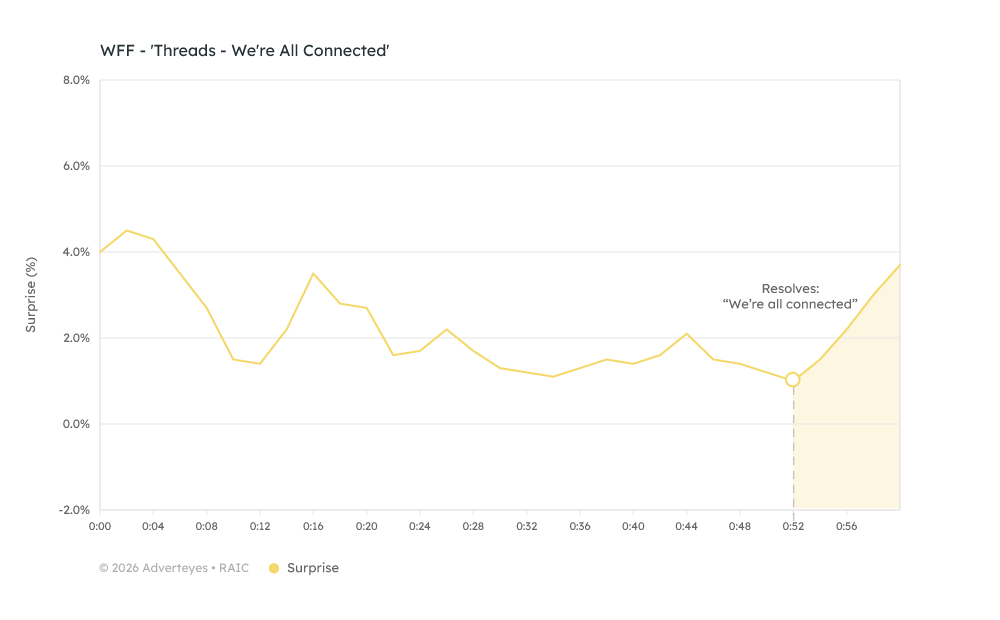
Similarly, a late reveal was a recurring feature of Surprise in this study: 7 of 12 ads (58%) used a revelatory line, slogan or voice-over to reframe the story late, rather than telegraphing the message early.
| Creative Device | Ads Using It (of 12) | Share |
|---|---|---|
| Revelatory text / slogan / voice-over | 7 | 58% |
| Abrupt plot twist | 4 | 33% |
Fig 7. Surprise Curve: The Late Reveal
In this example, the Surprise curve peaks at the late reveal, where the chaotic web of ‘Threads’ finally becomes one with the text, “We are all connected,” to resolve the ad.
Full Creative Device Reference
The table below consolidates every device identified across all four emotional categories, for reference.
| Category | Creative Device | Ads Using It (of 12) | Share |
|---|---|---|---|
| Attention | Thematic musical progression | 10 | 83% |
| Attention | Facial close-ups | 9 | 75% |
| Attention | Relationships / togetherness / empathy | 4 | 33% |
| Attention | Distinct sound effects | 4 | 33% |
| Attention | Revelatory text | 4 | 33% |
| Attention | Animals | 3 | 25% |
| Happy | Relationships / togetherness / empathy | 9 | 75% |
| Happy | Laughter / smiling | 5 | 42% |
| Happy | Musical progression / climax | 5 | 42% |
| Happy | Revelatory text / logo / voice-over | 5 | 42% |
| Happy | Irony / contradiction | 4 | 33% |
| Negative | Ominous imagery / dark color palette | 6 | 50% |
| Negative | Facial distress, pain, fear or rage | 6 | 50% |
| Negative | Abrupt / menacing sound | 3 | 25% |
| Negative | Small / cluttered text (avoid) | 3 | 25% |
| Surprise | Revelatory text / slogan / voice-over | 7 | 58% |
| Surprise | Abrupt plot twist | 4 | 33% |
Table 9. Creative devices by emotional category, ranked by how many of the 12 target ads used them during key scenes. Relationships/togetherness/empathy appears under both Attention and Happiness because the theme can peak at different moments for each metric.
THE AUDIENCE LESSON
Who Are We Designing For?
Attention was consistently higher among viewers 50+ than viewers under 49, while Engagement was more evenly spread across age bands (see Figs 8-9). Notably, this gap in Attention held even after removing campaigns explicitly about ageing (Cancer Research UK, Age UK, NYU Langone Heart). However, we have not tested this difference for statistical significance, so it should be read as an exploratory finding rather than a proven effect.
Fig 8. Engagement by Age
This shows an even distribution of Engagement across the age bands, whereas Attention was higher in the older age bands.
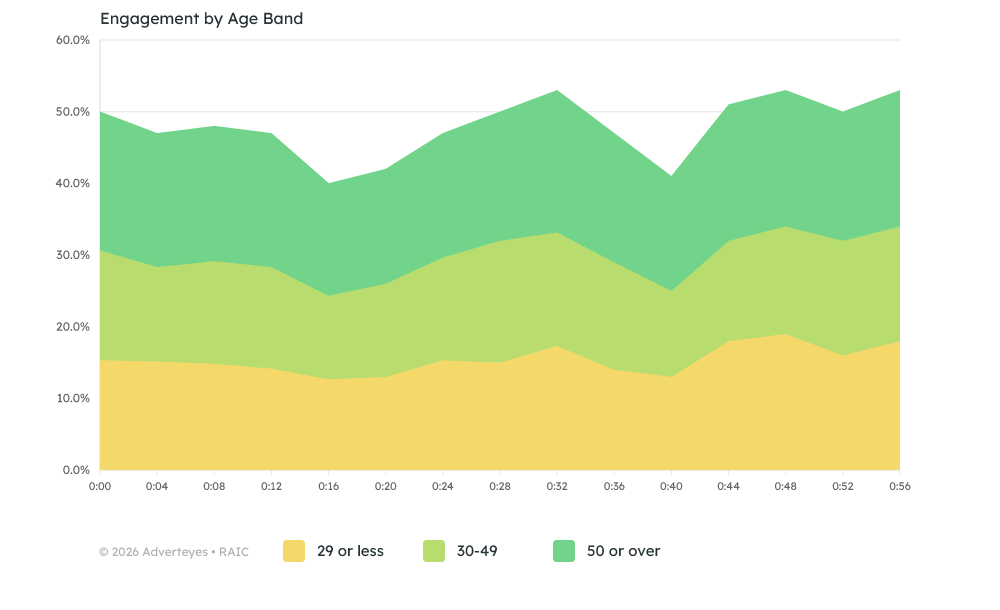
Fig 9. Attention by Age
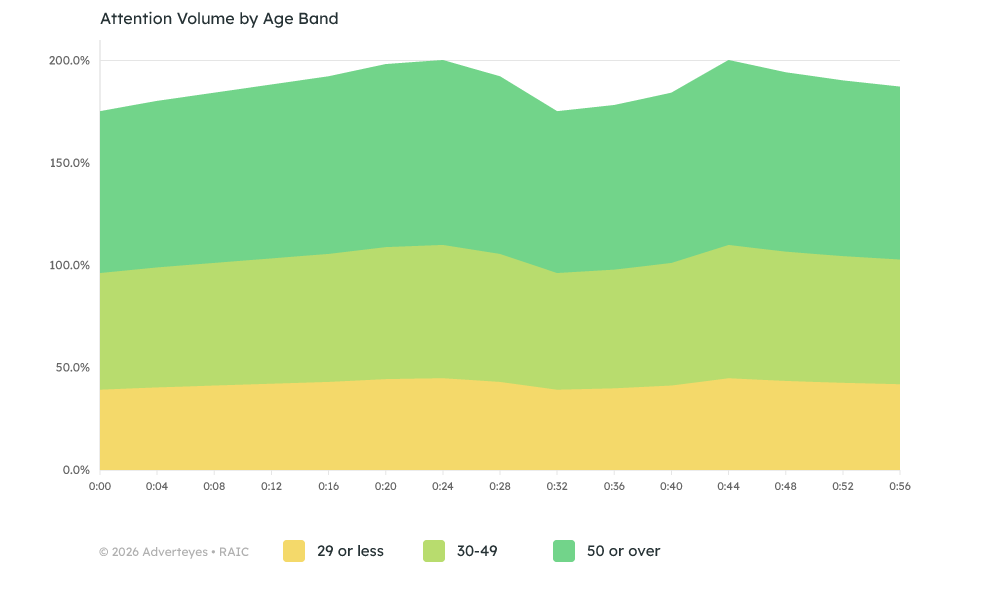
As a result, it suggests some charity creative may be built, consciously or not, around the tone, pacing, casting and cultural references that resonate with an older audience, even when the campaign’s donor base or the behavior it’s trying to shift skews younger. In short, creative effectiveness can change substantially depending on who’s watching. Ultimately, that’s a wider question than a targeting fix.
Creative effectiveness can change substantially depending on who’s watching. That’s worth building into the brief itself, rather than treating it as a media-planning afterthought further down the process.
Design for the audience you need to move, not just the one that feels natural to write for.
APPLYING THE FINDINGS
What This Means for Your Next Campaign
Charity and PSA campaigns are doing some of the hardest creative work in advertising, often on limited testing budgets. As a result, the patterns in this study point to a short list of questions worth asking at brief stage, not just post-production.
| Stage | Questions to Consider |
|---|---|
| Before production | What emotional journey should the audience experience? Where should Attention and Engagement peak, and what role does the brand play in that journey? |
| During editing | Would moving the end card close the gap between the emotional peak and the branding moment? Does branding appear while Attention and Engagement are still strong? If negative emotion is used, is it resolved into empathy or connection before the ad ends? |
| Before launch | Is the tone, pacing and casting built for the audience the campaign needs to persuade, or the audience it feels most natural to make? Does the branding land clearly for that audience? |
Table 10. A practical framework for applying these findings across the production process.
That said, none of these are prescriptive rules from a sample of 12 ads. They’re the questions this data set suggests are worth testing against your own creative before a campaign goes live.
APPENDIX
The 12 Ads in This Study
Most organizations are making high-stakes creative decisions without knowing whether the emotional moments they’re building will land, or whether the branding will show up in time to benefit from them. So: where does Attention peak? Where does emotion peak? Does the brand arrive at the same moment? Ultimately, Adverteyes Human Measurement can help answer those questions before a campaign goes live.
| Ad Name | Type | Market | Duration |
|---|---|---|---|
| WWF — ‘Threads / We Are All Connected’ | Charity / Non-Profit | US | :60 |
| UNICEF — ‘Dream On’ | Charity / Non-Profit | UK | :60 |
| Cancer Research UK — ‘Pink Army’ | Charity / Non-Profit | UK | :60 |
| Arthritis Research UK — ‘The Nation’s Joint Problem’ | PSA | UK | :60 |
| Energy Upgrade California | PSA | US | :60 |
| NCDV — ‘Abusers Always Work from Home’ | PSA | UK | :60 |
| Scope — ‘See the Person’ | Charity / Non-Profit | US | :30 |
| Age UK — ‘Love Later Life’ | PSA | UK | :30 |
| NO MORE — ‘Text Talk’ | PSA | US | :30 |
| NYU — ‘Langone Heart’ | Charity / Non-Profit | US | :30 |
| PETA — ‘Redemption’ | Charity / Non-Profit | US | :30 |
| Road Safety — ‘Life Is Fragile. Reduce Speed’ | PSA | UK | :30 |
Table 11. All 12 ads analyzed, split evenly across market (6 US, 6 UK) and format (6 x :30, 6 x :60).
This uses Adverteyes‘ Human Measurement approach: real, opted-in viewers watching naturally on their own device, with attention and emotion tracked frame by frame throughout the ad. See our full methodology page for more on how the measurement works.
NEXT STEPS
Does Your Campaign Land its Emotional Moment?
Most organizations are making high-stakes creative decisions without knowing whether the emotional moments they’re building will land, or whether the branding will show up in time to benefit from them. So: where does Attention peak? Where does emotion peak? Does the brand arrive at the same moment? Ultimately, Adverteyes Human Measurement can help answer those questions before a campaign goes live.