

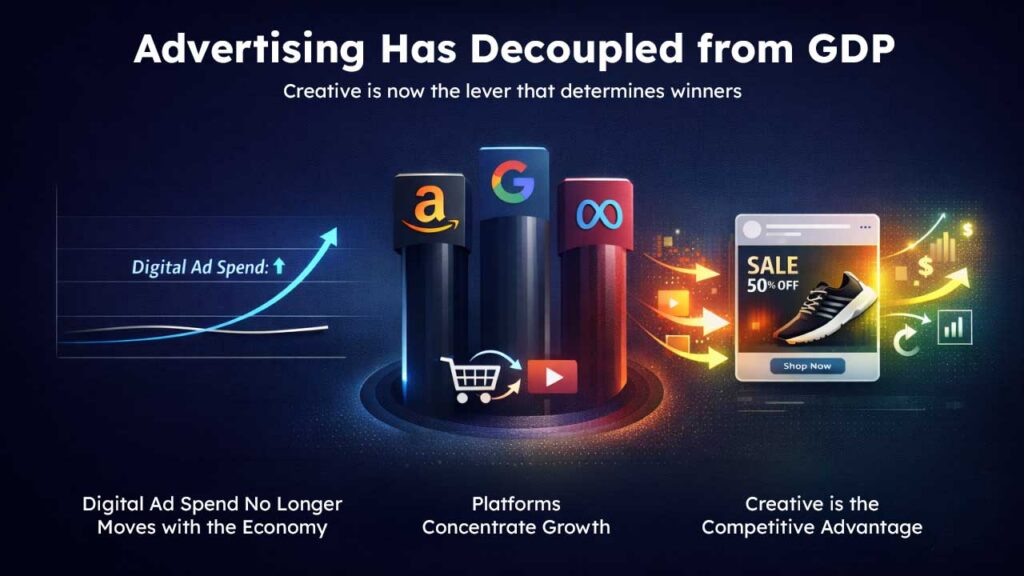
For the last half-century, advertising was a reliable economic barometer: total ad spend tended to move with the size of the overall economy. Historical U.S. data shows that advertising as a share of GDP stayed near long-run averages for decades, even as dominant media shifted from print to radio to television.
Digital channels made up nearly three-fourths of global advertising investment and about $790 billion of spend worldwide.
Digital is The New World Order
That story changed with digital media. In 2015, digital advertising accounted for roughly half of all ad spend; in 2024, digital channels made up nearly three-fourths of global advertising investment and about $790 billion of spend worldwide.
Global ad spend overall continues to grow, estimated to reach about $1.17 trillion in 2025. Though it is digital channels that drive nearly nine out of every ten dollars of incremental growth.
In the U.S., digital’s dominance is greater: more than 77% of all media ad budgets are now allocated to digital, with technology, retail and CPG brands directing more than 80% of spending to digital channels.
The ad economy has over-indexed for decades on media distribution, at the expense of the very thing it is distributing: the creative.
Platforms Concentrate Power & Performance
A handful of platforms now capture a disproportionate share of that growth. One industry forecast estimates that just three companies (Google, Amazon, and Meta) will account for more than 55% of global ad spend in 2025 (excluding China). In the U.K., Google and Meta alone received at least half of all ad dollars in 2024.
The concentration extends beyond volume: auction pricing, real-time bidding, first-party audience data and automated optimization systems make participation a challenge. For many Open Web publishers, which are not embedded in large commerce or social platforms, this has meant loss of scale and pricing power, as ad budgets flow disproportionately to platforms with richer data, tighter commerce integration and better user experiences. Word on the street is it’s really tough to be an Open Web publisher right now and it may get worse as younger generations don’t prefer to type “www” during their media experiences.
Creative drives 50%-70% of advertising's sales impact. Effective creative increases yield on every dollar spent, reduces cost per acquisition, and amplifies the value of targeting and optimization investments.
Advertising Evolves From Macro Input To Competitive Advantage
Advertising is no longer a stable percent of GDP that “grows with the economy.” It has become a primary driver of competitive differentiation, where brands with the right data, automation, and executional capabilities win. The agility of SMBs to adopt AI tools advantages them over slower-moving behemoths.
That’s also why the link between ad-creative effectiveness and competitive advantage has never been stronger. While platforms control audiences and auction mechanics, creative remains the major lever brands control that drives attention, conversion, brand memory, and economic impact. More succinctly, creative drives 50%-70% of advertising’s sales impact. Effective creative increases yield on every dollar spent, reduces cost per acquisition, and amplifies the value of targeting and optimization investments.
The ad economy has over-indexed for decades on media distribution, at the expense of the very thing it is distributing: the creative. When platforms, commerce integration and measurement systems shape where and how ads are delivered, creative effectiveness is the strategic frontier. Brands that invest in creative that is relevant, resonant, and optimized for platform-specific dynamics will outperform those that rely on reach or spend alone. Appending business-outcome performance to every creative becomes your primary competitive advantage, and key to brand sustainability.