


I recently spent a day at the Restecher Capital Markets Day with Patrick Comer, CEO of Cint, one of the largest research respondent marketplaces. We talked about verified human signal, and he left me with one idea I can’t shake:
"As AI automates the market intelligence value chain, verified human signal is getting more valuable."
Demand for Real Humans is Rising
According to Comer, the price and the quantity of human participants in marketing measurement are going up at the same time. When price rises and volume falls, you have scarcity. When both rise together, you have demand.
As Comer told Axios:
"The difference between an AI slop response versus a verified human response, the value is so vastly different."
Synthetic and modeled data is exploding. So is the demand for verified human data to ground it.
Agents Are Posing as Humans
More than half of web traffic on Cloudflare‘s network is now machine generated, and daily requests from AI agents grew more than 1,700% in a year.
Research panels are not immune. Kantar, which partners with Realeyes (the company Adverteyes grew out of) on survey fraud, found that researchers discard, on average, up to 38% of the data they collect because of low quality, duplicate respondents and panel fraud. And the industry average for catching fraud before a survey runs is just 32.2%.
If more than a third of your data can’t be trusted, every model trained on it inherits the noise. The solution is verified humans, not more filtering after the fact.
Agents Are Also Showing Up as Buyers
Gartner forecasts AI agents will intermediate more than $15 trillion in B2B spending by 2028. Two in three video ad buyers are testing or planning to use agentic AI, half for creative testing and optimization, according to the IAB in Mediapost.
That means market intelligence has two new jobs:
- Block agents posing as human respondents, so the signal feeding decisions, models and predictions stays human.
- Serve agents arriving as buyers. Attract and qualify them and give them what they need to make good advertising decisions based on verified human signal.
AI models will drive more demand for verified human signal. To train. To calibrate. To verify. And to settle high-stakes decisions.
Market Intelligence Demand Poised to Grow
Human signal remains the gold standard for fidelity. AI-powered modeling, prediction and simulation extend its relevance, footprint and access.
For decades, intelligence lived behind the manual workflows of the research department. When it reaches frontline stakeholders at the moment of decision, the market expands, and that intelligence gets priced at a premium while driving more business impact.
AI models will drive more demand for verified human signal. To train. To calibrate. To verify. And to settle high-stakes decisions.
...take a fix on a known light, check a sounding against the chart, reset and keep going.
The Future is a Flywheel
Anyone who has run a boat in fog understands the importance of dead reckoning and taking a fix. Dead reckoning on heading, speed, time and drift keeps you moving when a verified reading is slow or impractical. But its error compounds. So you take a fix on a known light, check a sounding against the chart, reset and keep going.
Models and simulations are like dead reckoning. Verified human response is the fix. You need both. Only the fix tells you where you actually are.
The future of advertising intelligence runs on a flywheel with verified human ground truth at the center.
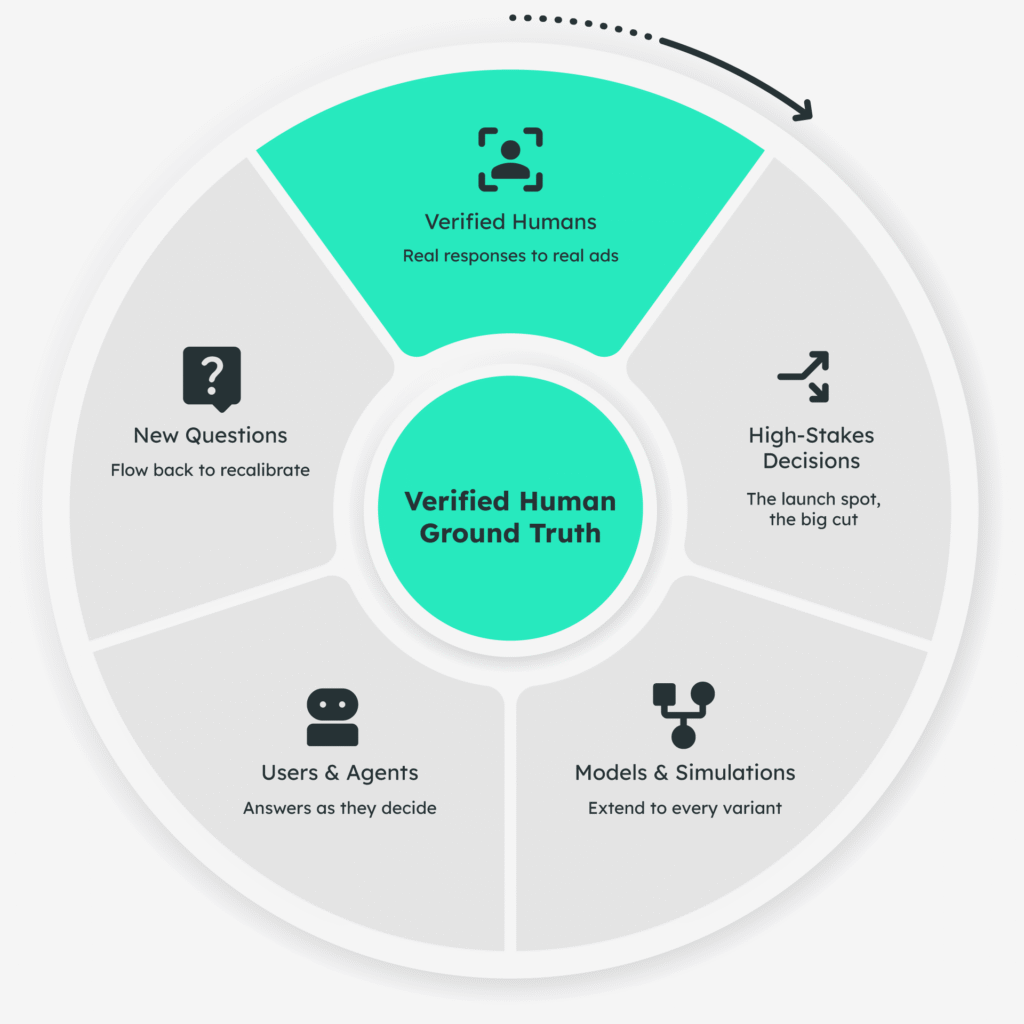
Verified humans answer high-stakes calls directly. Models learn from that signal and extend it to every variant, market and format. Users and agents get those answers where they work. New questions flow back to verified humans, and the models recalibrate.
Take the center out and the wheel still spins. It just stops pointing at the truth.
What This Means for Creative Decisions
Creative drives 50 to 70% of sales variance. It is also the decision most exposed to low-quality synthetic shortcuts, or no signal at all. Adverteyes was built on the opposite premise: every prediction should root back to verified human response.
- Ground truth at scale. More than 18 million human behavior, attention and emotion observations across 90 countries.
- Live human testing that never stops. Fresh responses keep feeding and recalibrating our models.
- Answers where people decide. Sales, Brand and Conversion predictions and creative recommendations reach planners, creative teams and agents via platform, API and MCP.
- A clean boundary. We don’t generate ads. We assess how humans will respond to them. We show you how to make them perform.
For the high-stakes launch, test with verified humans. For the millions of variants that follow, predict with models anchored in that same human response.
Proof Keeps Prediction Honest
More agents. More models. More synthetic answers. Fine. But every answer is only as good as what it was verified against.
So ask your creative intelligence partner these four questions. Here’s how we answer them:
Where does your ground truth come from?
More than 18 million human attention and emotion observations across 90 countries.
How do you verify humans are human?
Every respondent is verified with [VerifEye], Realeyes’ identity verification, so we know they’re human.
What happens when the model and the humans disagree?
The humans win, and the model recalibrates.
How does your signal calibrate to business outcomes?
Our predictions are modeled against brand affinity and Sales Lift data.
If your partner can’t answer all four, you’re navigating by dead reckoning.