

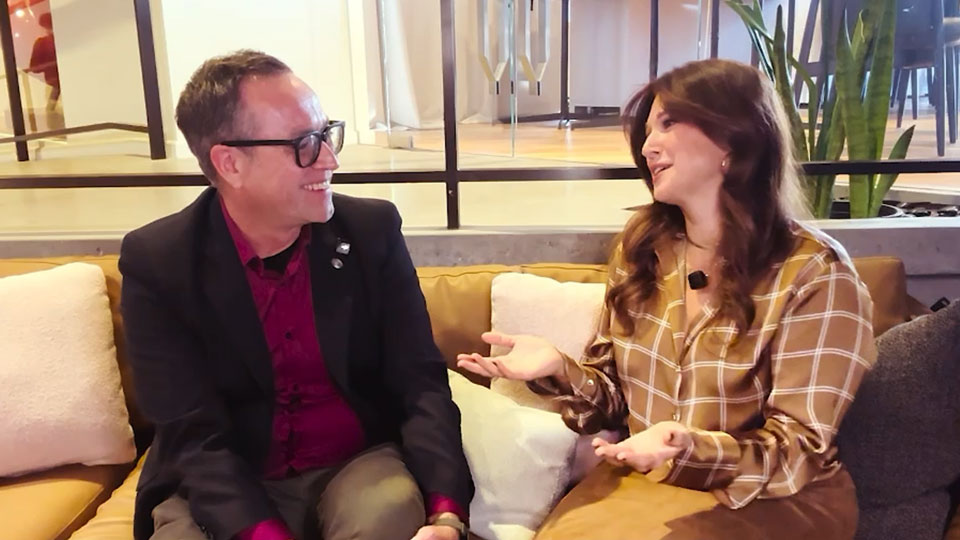
At Advertising Week New York 2026, Adverteyes CEO Max Kalehoff sat down with Aubriana Lopez for Agents of Change: Human in the Loop. They spoke at the Advertising Economic Forum, a home for conversations about capital, venture and where the industry’s money should go.
Max’s answer to that question was consistent. Put it into creative. Then make creative and media work as one system. Watch the full eight-minute conversation below or read on for the key points.
Thanks to Aubriana Lopez and Agents of Change: Human in the Loop for the conversation.
What Adverteyes Does
Adverteyes connects creative with sales outcomes. Max explained that the company has observed 18 million people responding to ad content in 90 countries, across all major ad platforms. It collects that response data continuously, using webcams and observational techniques.
AI then turns that data into a prediction model. Max calls the result creative intelligence: an understanding of how real people respond to ads and what that response means for sales.
Generative AI Needs Better Briefs, Not More Output
AI can produce a thousand versions of an ad before lunch. So how does a marketer know which one will work before spending the media budget?
Max started with a reality check. Once the novelty wears off, generative AI gets expensive. Every click of the submit button costs money. And without direction, AI produces a lot of slop.
“You need to be able to put that intelligence about humans, about response, about results and sales up front into the brief, or into the prompts in the case of an AI.”
The fix starts before any asset is generated. Better creative briefs, built on a real understanding of how consumers respond in each ad scenario, lead to better output. Without that intelligence, teams are just trading speed for cost.
Human Data is the Moat
As more content becomes machine-made, does human signal become more or less valuable? For Max, it is the foundation.
Adverteyes works on the hypothesis that first-party, high-quality human data is the most important moat in the business. The company has invested heavily in collecting it, and the collection is self-sustaining. Max described that data as the ground truth of reality. It is what the models train on and what makes predictions useful to advertisers.
Retire the Vanity Metrics
Asked which metric he would kill tomorrow, Max named three that all roll up to one:
- Click-through rate. A single point in the conversion path that means nothing on its own.
- View-through rate. The video version of the click-through. It means almost nothing.
- An efficiency metric with very little relationship to an advertiser’s sales outcome.
ROAS might matter as a step towards something larger. But it is not something to celebrate on its own. Max’s concern is that too many agency reports to clients still lead with it. When Aubriana later asked for one acronym to retire forever, there was no hesitation. ROAS.
Max made the same case in his recent post on the creator economy: ROAS wins delivery, but ROI wins sales. Use ROAS to manage delivery efficiency. Judge what actually drives sales with incrementality tests, marketing mix models and sales validation.
Put the Money into Creative
Given an absurd budget to invest in one area of advertising, Max called it the easiest question of the day.
“Creative drives 50 to 70% of sales variance. In a world of automation, creative is the final frontier of optimization and performance.”
Creative matters more than media or targeting. As media buying becomes more automated, creative is where the real gains remain. Max believes most advertisers could dial up their creative investment and skills and make their media work three, four or five times as hard.
Break Down the Creative and Media Silo
The change Max is pushing for, even if the industry isn’t ready, is to break down the silos between creative and media.
He sees creative and media data as abstractions. The advertising industry created them for efficiency, based on the economics of holding companies 50 years ago. It is time to make the system work together, for better consumer experiences and better results for advertisers.
He came back to the same pair when asked which two areas still don’t talk to each other. Creative can make media work harder. And media is the world’s largest stimulus-and-response environment, the best place to test and understand consumers.
See What Your Creative Will Do Before You Spend
Adverteyes brings creative intelligence into the brief, the prompt and the decision. It shows how real people will respond to your ads and what that means for sales, before the media money goes out.
Talk to the Adverteyes team to see how it works on your own creative.