


By now you’ve probably seen Punch, the baby macaque at the Tokyo Zoo who went viral after being rejected by his tribe. In the footage circulating across every major platform, he clings to a plush orangutan toy for comfort. The videos are heartbreaking.
They may also be the best unplanned product placement IKEA has ever received.
Punch’s constant companion is an IKEA plush. And across thousands of video clips, it appears front and center, replayed by news organizations, remixed by creators, and shared raw on YouTube Shorts, Instagram Reels and TikTok. The content keeps multiplying, organically, with zero media spend from the brand.
What the Data Actually Shows
Curiosity got the better of me. I ran 10 Punch videos — sourced across YouTube, Instagram, and TikTok, through the Adverteyes.ai creative intelligence system to see how they scored against our benchmarks. The results were striking.
75
Average Sales Impact score out of 100 across 10 Punch videos (range: 66–91)
Top 25%
Percentile rank vs. hundreds of thousands of video shorts scored to date by Adverteyes
For context, most branded content, content that brands have scripted, produced, and paid to distribute, doesn’t come close to these numbers. The Punch videos are sitting comfortably in the top quartile of everything our system has ever evaluated. That’s a remarkable result for footage that nobody planned.
What makes this unusual is that the product isn’t incidental. In a standard cute-animal video, a brand logo might flash in a corner for two seconds and vanish. Here, the IKEA plush is Punch’s constant companion. It’s the second character in almost every frame. The emotional attachment a global audience is developing toward Punch is, by extension, being transferred to that toy.
"The emotional attachment a global audience is developing toward Punch is, by extension, being transferred to that toy."
Where the Story Gets Complicated
There’s a catch — and it’s an important one for anyone tempted to declare this a marketing home run for IKEA. Brand recognition is a very different story from sales potency.
CIA evaluates the full context: market, audience, platform, ad format, creative content, narrative and campaign goal. The result: you know why an ad underperforms, and exactly what to change."
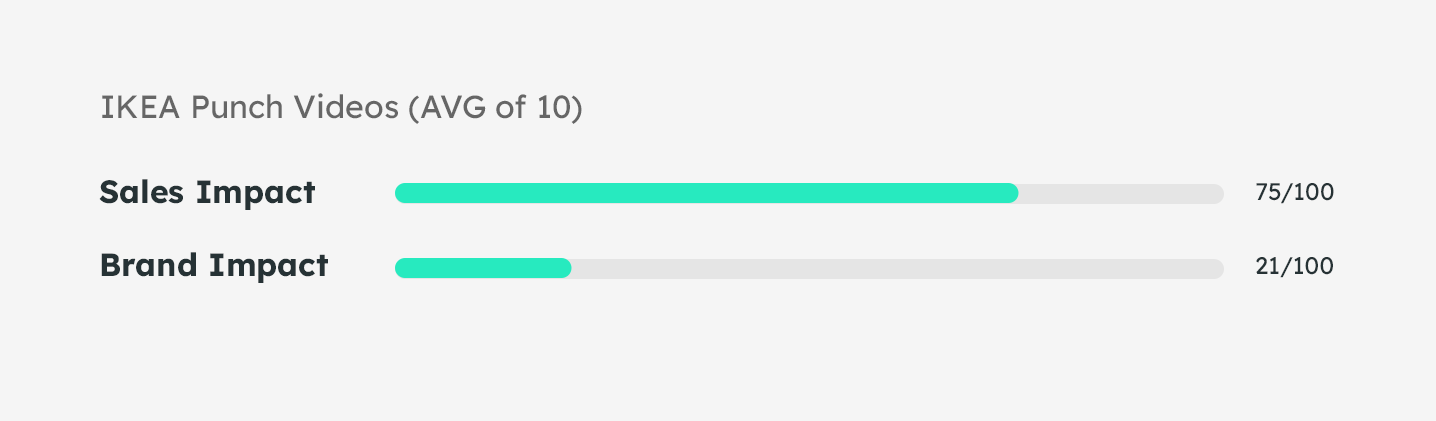
The Adverteyes Brand Impact score across the same Punch videos averaged just 21 out of 100. Social commentary confirms the split: many viewers recognize the toy and feel something toward it, but most do not connect it to IKEA. Explicit IKEA branding is largely absent from the videos, which is entirely understandable, since this is organic, user-generated content. Nobody is tagging the brand. Nobody is typing the URL into the description.
The result is high sales potency for the plush toy category overall, with diluted brand benefit for IKEA specifically. The halo is there, it’s just floating above an unlabeled product.
The Lesson That Keeps Getting Missed
This is a useful, concrete reminder of something the industry has debated abstractly for years: virality and brand-building are not the same thing. A piece of content can generate enormous emotional engagement, deliver outstanding predicted sales impact, and still fail to move the needle on brand recall or attribution. The two metrics require different ingredients.
Sales impact is driven by attention, emotion, and product visibility. Brand impact requires clear attribution — logos, names, consistent visual identity. Organic UGC almost never delivers both simultaneously without deliberate amplification.
Playbook: If Your Brand Finds Itself in This Moment
- Move immediately, viral moments have a narrow half-life. The window is measured in days, not weeks.
- Amplify with paid media to extend reach and recapture the audience already engaged organically.
- Create branded offshoots official content, creator partnerships, in-store tie-ins that attach your name explicitly to the story.
- Prioritize attribution clarity in everything you produce: name the brand, show the logo, make it unmistakable.
- Use creative intelligence scoring to identify which organic clips are performing best before deciding where to spend.
The Window is Open, IKEA
Punch won’t be front-page news forever. The compression of the attention economy means the cycle from “going viral” to “yesterday’s news” is shorter than ever. Right now, the IKEA plush is appearing in front of tens of millions of people who are emotionally primed. That’s an extraordinary starting position — but only if the brand moves to claim it.
The Adverteyes data tells us the sales signal is real and strong. The brand signal needs work. Fortunately, one of those things is within IKEA’s control, starting today.
And if you’re curious — yes, you can still purchase the plush orangutan directly on the IKEA website. Punch would probably approve.