

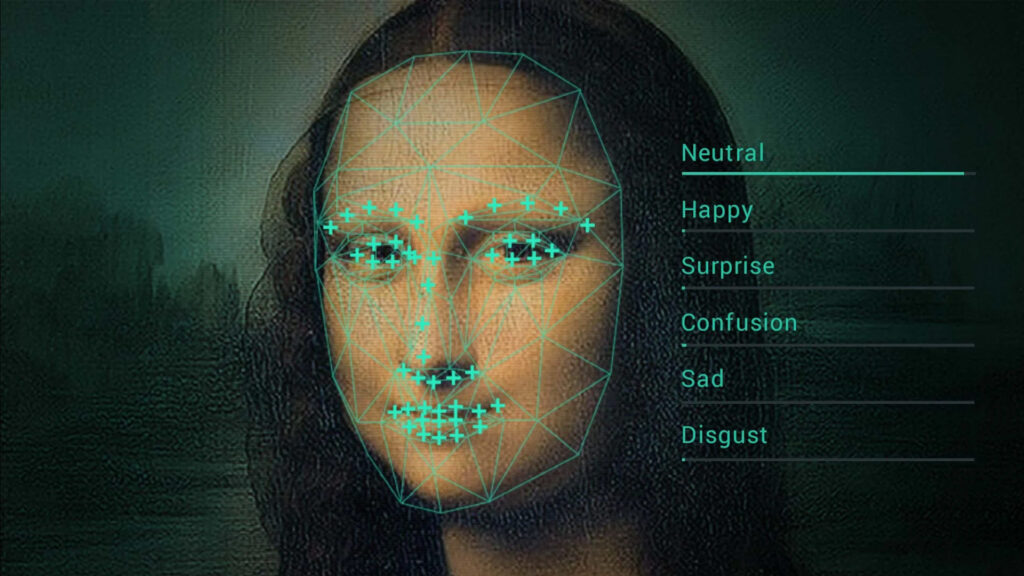
Leonardo da Vinci’s Mona Lisa is one of the most famous paintings in art history, captivating viewers for centuries with her ambiguous expression. That enigmatic quality, her slightly bemused smile that suggests she might be holding back a secret—has sparked endless debate about what she’s really feeling.
Human measurement technology provides clarity where human perception finds ambiguity.
Part of the mystery lies in an optical illusion. There’s a conflict in how our brain interprets the fine details of her features against the shapes and shadows across her face. Focus on her eyes, and your peripheral vision reads the dark shadows around her mouth, enhancing the perception of a smile. Shift your gaze to her lips, and the shadows around her eyes seem to diminish it. This visual tension, combined with centuries of interpretation, has fueled our fascination with the work.
But when we apply facial coding technology to analyze her expression, something remarkable emerges: there’s no conflict at all. The data reveals that da Vinci painted an almost completely neutral face. Perhaps it’s precisely this lack of strong emotional signals that gives the painting its enduring mystery.
This is where human measurement transforms our understanding. At Adverteyes.ai, we use advanced Vision AI and facial coding to decode human expressions with scientific precision – the same technology that can analyze Mona Lisa’s enigmatic face can measure real-time emotional responses from viewers and consumers. While traditional observation might see a smile or detect subtle amusement, human measurement cuts through subjective interpretation to reveal objective emotional data.
Facial coding maps expressions by identifying micro-movements in facial muscles, tracking indicators of happiness, surprise, confusion, sadness, disgust, and neutral states.
When applied to the Mona Lisa, our emotion measurement confirms what the data shows: an exceptionally neutral expression. In many parodies and posters featuring her image, artists instinctively strengthen her smirk, as if compelled to add the emotional narrative that da Vinci deliberately or perhaps accidentally withheld.
Unlike Renaissance masters who often told stories through expressive faces—from Rubens to Rembrandt, whose portraits draw viewers in through emotional contagion, da Vinci may have intentionally avoided this connection. Or perhaps Mona Lisa had simply grown weary of holding a smile for hours, and da Vinci captured that transitional moment perfectly: a mashup of emotions that causes us to re-read her face again and again.
Whether by design or happenstance, human measurement technology provides clarity where human perception finds ambiguity. At Adverteyes.ai, this same precision helps brands understand how audiences truly respond to content, advertising, and experiences, moving beyond guesswork to data-driven insights about human attention and emotion.
Mystery solved? When it comes to measuring human response, the answer is yes.