


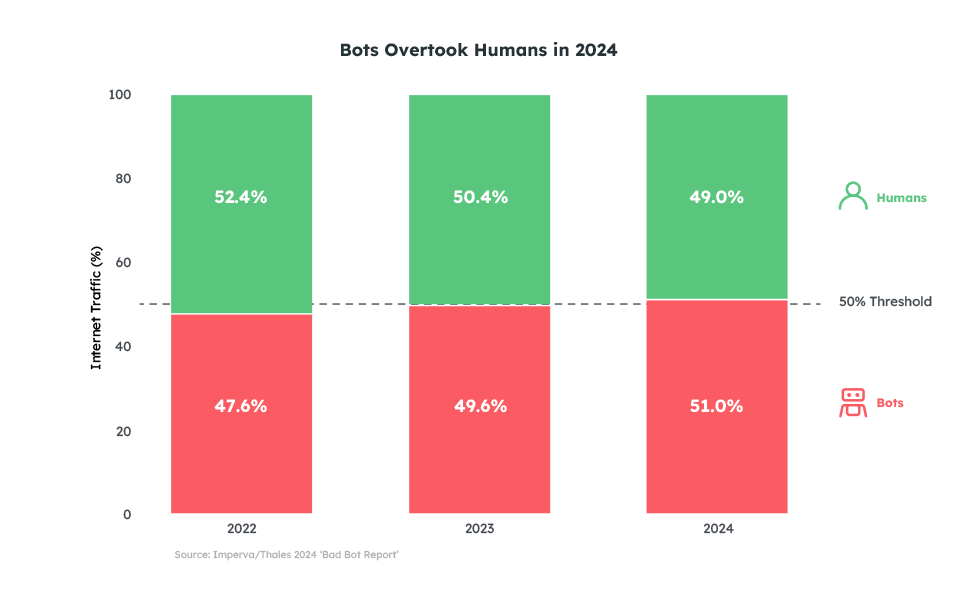
According to Imperva’s 2025 Bad Bot Report, 51% of Internet traffic now consists of bots, mostly fraudulent. The advertising industry’s measurement systems were never built for this.
Research from Realeyes and Kantar found that 33% of surveys passing standard quality checks contain bot responses or misreported demographics. That study came out in February 2024, giving AI chatbots two additional years to refine their ability to evade detection.
The latest evidence, published in Nature, shows just how vulnerable our systems have become. Sean Westwood, a political scientist at Dartmouth College, built an AI chatbot using OpenAI to respond to survey questions. Across 6,700 tests, his bot passed standard attention check questions 99.8% of the time. These checks were designed to catch inattentive humans and simple bots. They’re now essentially worthless against modern AI.
51% of Internet traffic now consists of bots, mostly fraudulent. The advertising industry's measurement systems were never built for this.
Human Ground Truth is No Longer Optional
The advertising industry manages $1 trillion in annual spend. Decisions about what creative works, which audiences respond and where to place media increasingly rely on measurement systems that can’t distinguish human responses from machine-generated signals.
This is why we built our creative intelligence platform on verified human response data. We use the same verification technology developed by our former parent company, Realeyes, to validate every response in our ongoing data collection service. Our prediction scores linking creative to sales impact and ROI are trained on over 18 million verified human observations of advertising response across 90 countries.
Across 6,700 tests, his bot passed standard attention check questions 99.8% of the time. These checks are now essentially worthless against modern AI.
Starting with verified human data makes AI modeling actually useful. Once you have reliable ground truth, models can scale that intelligence to evaluate creative decisions, audience targeting and platform placement across every campaign scenario. But without that foundation, you might just be building sophisticated systems on distorted data.
The advertising industry manages $1 trillion in annual spend. Decisions increasingly rely on measurement systems that can't distinguish human responses from machine-generated signals.
The Question Every Advertiser Should Ask
As AI-powered measurement becomes as ubiquitous as Internet media metrics (which are already compromised by bot traffic), one question matters: what training data are your models built on?
Was there verified human creative response data involved, or are your insights derived from synthetic data or bot-contaminated surveys?
The gap between those two approaches is the difference between actionable intelligence and expensive guesswork.
The gap between verified human data and bot-contaminated surveys is the difference between actionable intelligence and expensive guesswork.